Where your pricing knowledge actually lives
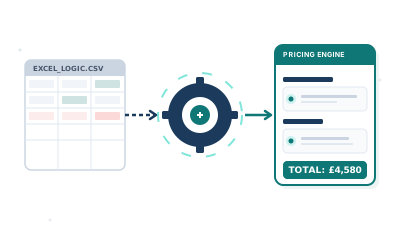
A fabrication shop owner once showed me how they quote jobs. He opened a 14-tab Excel workbook, entered the material specs, adjusted a few cells, cross-referenced a printed rate card from 2019, and arrived at a number. Then he said: "Most of our pricing is in here, but Rob knows when to add extra."
Rob was their senior estimator. Rob had been there 22 years.
I asked what happened when Rob went on holiday. There was a pause.
The pause is the interesting part, not the workbook. The most valuable pricing asset in that business was a person, and nobody had ever said it out loud.
The same problem, across every industry
I have had a version of that conversation with manufacturers, professional services firms, trades companies doing solar and retrofit, and signage suppliers. The sectors were different. The pricing problems were nearly identical.
"Our quotes take three days on complex jobs." "The person who built our quoting spreadsheet left two years ago. We maintain it now, but nobody fully understands it." "We lose margin on anything out of the ordinary because the estimate doesn't catch it." "We can't scale the sales team because only two people know how to price."
Pricing and quoting is where operational risk concentrates. Get the price wrong and you erode margin. Get the turnaround wrong and you lose the deal. Keep the knowledge in one person's head and you have a key-person dependency that nobody talks about until it becomes urgent.
Spreadsheets are the symptom, not the problem
The spreadsheet isn't the real issue. The real issue is that pricing rules are almost never written down.
They live in cells referencing cells, adjusted incrementally over years until nobody remembers the original logic. They live in the muscle memory of estimators who know "a job like this runs about £X before you add for access." They live in comments on past quotes, like a note from 2021 saying "added 15% for awkward site layout."
The rules exist. They're coherent. They work. They've just never been articulated. The estimator can't hand you a decision tree. They can show you the output.
Here's what that looks like once it's extracted and written down:
| Condition | Adjustment |
|---|---|
| Standard materials | × 2.3 markup |
| Stainless steel | × 2.8 markup |
| Job value under £500 | Minimum 35% margin floor |
| Site within M25, no client parking | +12% access surcharge |
| Public sector client | +8% contingency |
That's five rules. A real engagement surfaces 30, 40, sometimes more. The point of writing them down isn't to replace the estimator's judgement. It's to make that judgement portable.
Why generalist advice doesn't solve this
If you search for solutions to this problem, you'll find three categories:
SaaS quoting tools. Generic templates with fixed field types. If your pricing rule is "material cost × 2.3, except stainless steel which gets × 2.8, with a minimum margin floor, and a site-access modifier that depends on location", you can't model that in a template. You either approximate or you don't use it.
ERP systems. Built for mid-market, expensive to implement, and the pricing configuration is usually buried under a six-month onboarding process. The pricing logic is hard to see, harder to change.
Generalist software agencies. They'll build exactly what you spec. But most businesses can't spec a pricing engine, because they have never had to articulate one before. The agency asks "what do you want it to do?" and waits for an answer. The more useful question runs the other way round: what did you charge for the last awkward job, and what made it that number?
The gap between "we need better quoting" and a working, tested quoting engine is mostly that question, asked forty times.
Getting the rules out of someone's head
This is an interview problem before it is a software problem.
Ask an estimator to describe how they price and you get the tidy version: the markup, the rate card, the standard terms. The parts that matter are the exceptions, and nobody volunteers an exception, because to them it isn't one. It's just Tuesday.
Starting from real jobs works better. Pull twenty quotes from the last year, pick out the odd ones, and go through them line by line. Why is this one 8% higher than a near-identical job three months earlier? The answer is nearly always a rule. Write it down, then go looking for a job where that rule should have applied and didn't. That second step is where the condition you would otherwise have missed turns up.
Then the engine has to prove itself, and a quoting engine is one of the few systems you can test against reality, because the business already holds the answers. Every job it has delivered and invoiced is a worked example. Run those past jobs through the engine and compare its output with what was actually charged. Where the two disagree, either the rule is wrong or the original quote was. The second case is the one that tends to surprise people.
The finished thing has to stay readable, too. If the rules end up buried in code or in formulas only I can follow, the business has swapped one dependency for another. The test I use: can the estimator read the rule list and argue with it? If they can point at row 14 and say that isn't right any more, the knowledge has left their head and landed somewhere the business owns.
Who this is actually for
Not every business needs a custom quoting engine. If your pricing is a straightforward rate card or simple unit pricing with no customisation, you probably don't.
But if any of these are true:
- Quotes take more than 30 minutes on complex jobs
- Your senior estimator is a single point of failure for pricing knowledge
- You've lost deals because you couldn't turn a quote around fast enough
- Margin varies significantly across similar jobs and you don't fully understand why
- You're trying to grow your sales team but pricing knowledge isn't transferable
then it is worth solving properly.
The businesses where this bites hardest share a common thread: the work is non-trivial to estimate, the rules matter, and the person who knows them hasn't written them down. Specialist manufacturing, professional services with complex scoping, trades with project pricing. Different sectors, same root problem.
If your pricing currently lives in a spreadsheet, or in one person's head, that is worth a conversation. I offer a free 30-minute call: you walk me through how you quote today, and I will tell you where the friction looks worst and whether a quoting engine is actually the right answer. Book one here.