The Hidden Cost of Manual Data Entry and How to Eliminate It
If you walk into almost any small business office in the UK, you will likely find someone spending their morning moving information from one place to another. They might be copying details from an email into a CRM, typing invoice data into an accounting package, or updating a spreadsheet with figures from a website.
To a business owner, this looks like "work." In reality, it is a massive bottleneck. Manual data entry is one of the most expensive ways to run a business, not because of the hourly wage you pay the person doing it, but because of the hidden costs that never show up as a line item on your P&L statement.
The true price of human error
Humans are not built for repetitive, high-volume data tasks. Boredom sets in, attention drifts, and eyes skip lines. In the software world there is a name for this, the "1-10-100 rule" of data.
It costs £1 to verify data at the point of entry. It costs £10 to fix an error later (cleansing the data). It costs £100 if that error is never caught and leads to a failed delivery, a wrong invoice, or a lost customer.
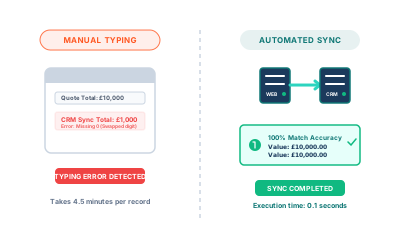
When an employee types "£1,000" instead of "£10,000" into a quote, or swaps two digits in a customer's phone number, the ripple effects are costly. You lose time fixing the mistake, you lose professional credibility, and in some cases, you lose the revenue entirely. Automation doesn't just work faster; it works with a level of precision that a tired human cannot maintain over an eight-hour shift.
The opportunity cost of stagnation
Every hour an employee spends on data entry is an hour they aren't spending on high-value tasks. For a small business, this is the biggest "hidden" cost.
If your office manager is spending 10 hours a week manually reconciling spreadsheets, that is 10 hours they aren't using to improve customer service, negotiate better rates with suppliers, or help you scale your operations. You are essentially paying a premium for a human to act like a slow, expensive piece of software.
When you eliminate manual entry, you don't just "save time." You reclaim the mental energy of your team. Employees who are freed from mindless clicking and typing are generally more engaged and more likely to contribute ideas that actually grow the business.
Why spreadsheets are a temporary band-aid
Many businesses rely on Excel or Google Sheets as their primary data hub. While these tools are powerful, they often become the source of the manual entry problem. One person updates a sheet, another person downloads it, a third person adds a column, and suddenly you have four "master" versions of the same data.
This creates "siloed data." When your information lives in disconnected files, someone has to act as the bridge between them, manually copying and pasting to keep everything in sync. This is a fragile way to operate. If that person leaves the company or goes on holiday, the bridge collapses.
Practical ways to eliminate the manual grind
You don't need a multi-million pound budget to fix this. Most manual data entry can be eliminated by connecting the software you already use or building small, custom scripts to handle the heavy lifting.
1. API Integrations Most modern business tools (Shopify, Xero, HubSpot, etc.) have an API, an Application Programming Interface. Think of an API as a digital handshake. Instead of a human downloading a CSV from your website and uploading it to your CRM, an API allows the two systems to talk to each other directly in real-time.
2. Optical Character Recognition (OCR) If your team spends hours typing data from paper invoices or PDF receipts into your system, OCR is the solution. Modern AI models can "read" these documents, extract the relevant fields (like date, VAT, and total amount), and push them directly into your database.
3. Custom Automation Scripts Sometimes, off-the-shelf tools don't quite fit your specific workflow. This is where a small bit of custom code can save hundreds of hours. For example, a simple Python script can monitor a folder for new files, extract the data, and update your internal systems automatically.
A technical example: automating lead entry
To give you an idea of how simple this can be, look at this logic. Instead of a staff member checking an email and typing lead details into a database, a developer can write a script that does this:
import imaplib
import email
import sqlite3

# Connect to the email server and find unread leads
def process_new_leads():
    mail = imaplib.IMAP4_SSL('imap.yourprovider.com')
    mail.login('info@yourbusiness.co.uk', 'password')
    mail.select('inbox')

    # Search for emails with 'New Lead' in the subject
    result, data = mail.search(None, '(SUBJECT "New Lead")')

    for num in data[0].split():
        result, msg_data = mail.fetch(num, '(RFC822)')
        # Logic to parse the email body for Name, Email, and Service
        lead_info = parse_email_body(msg_data[0][1])

        # Insert directly into your CRM or database
        save_to_database(lead_info)
        print(f"Processed lead: {lead_info['name']}")

def save_to_database(info):
    conn = sqlite3.connect('business_data.db')
    cursor = conn.cursor()
    cursor.execute("INSERT INTO leads (name, email, service) VALUES (?, ?, ?)",
                   (info['name'], info['email'], info['service']))
    conn.commit()
    conn.close()
This script doesn't get bored. It doesn't take lunch breaks. It processes every lead the second it arrives, ensuring your sales team can react instantly.
Moving toward an automated future
The goal of automation isn't to replace your staff; it's to give them better tools. By removing the "grunt work," you allow your business to scale without needing to hire a new person every time your volume of data increases.
At Etminan AI Solutions, I help UK small businesses identify these hidden drains on their productivity. Whether it's building a custom web app to replace a messy spreadsheet or setting up AI-driven automation to handle your invoicing, I focus on solutions that provide a clear return on investment.
If your team is buried in manual data entry, it's time to stop treating the symptoms and fix the system. Get in touch today to discuss how I can help you build a more efficient, automated business.