The Case for Specialising in Pricing & Quoting Engines
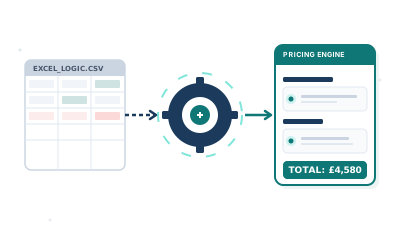
A fabrication shop owner once showed me how they quote jobs. He opened a 14-tab Excel workbook, entered the material specs, adjusted a few cells, cross-referenced a printed rate card from 2019, and arrived at a number. Then he said: "Most of our pricing is in here, but Rob knows when to add extra."
Rob was their senior estimator. Rob had been there 22 years.
I asked what happened when Rob went on holiday. There was a pause.
That conversation is the reason we built a consultancy around pricing and quoting engines instead of general software.
The same problem, across every industry
When we were working out what kind of consultancy to be, we spoke to a wide range of businesses. Manufacturers, professional services firms, trades companies doing solar and retrofit, signage suppliers. The sectors were different. The pricing problems were nearly identical.
"Our quotes take three days on complex jobs." "The person who built our quoting spreadsheet left two years ago — we maintain it now but nobody fully understands it." "We lose margin on anything out of the ordinary because the estimate doesn't catch it." "We can't scale the sales team because only two people know how to price."
Pricing and quoting is where operational risk concentrates. Get the price wrong and you erode margin. Get the turnaround wrong and you lose the deal. Keep the knowledge in one person's head and you have a key-person dependency that nobody talks about until it becomes urgent.
Spreadsheets are the symptom, not the problem
The spreadsheet isn't the real issue. The real issue is that pricing rules are almost never written down.
They live in cells referencing cells, adjusted incrementally over years until nobody remembers the original logic. They live in the muscle memory of estimators who know "a job like this runs about £X before you add for access." They live in comments on past quotes — a note from 2021 saying "added 15% for awkward site layout."
The rules exist. They're coherent. They work. They've just never been articulated. The estimator can't hand you a decision tree. They can show you the output.
Here's what that looks like once it's extracted and written down:
| Condition | Adjustment |
|---|---|
| Standard materials | × 2.3 markup |
| Stainless steel | × 2.8 markup |
| Job value under £500 | Minimum 35% margin floor |
| Site within M25, no client parking | +12% access surcharge |
| Public sector client | +8% contingency |
That's five rules. A real engagement surfaces 30, 40, sometimes more. Our job in the discovery phase is to sit with the estimator and extract them — not to replace their judgement, but to make it portable.
Why generalist advice doesn't solve this
If you search for solutions to this problem, you'll find three categories:
SaaS quoting tools. Generic templates with fixed field types. If your pricing rule is "material cost × 2.3, except stainless steel which gets × 2.8, with a minimum margin floor, and a site-access modifier that depends on location" — you can't model that in a template. You either approximate or you don't use it.
ERP systems. Built for mid-market, expensive to implement, and the pricing configuration is usually buried under a six-month onboarding process. The pricing logic is hard to see, harder to change.
Generalist software agencies. They'll build exactly what you spec. But most businesses can't spec a pricing engine — because they've never had to articulate one before. The generalist agency will ask "what do you want it to do?" and wait for an answer. We know what questions to ask instead.
That gap — between "we need better quoting" and a working, tested, maintainable quoting engine — is where we work.
What focusing on one problem changed
When we stopped taking general software work and committed to pricing and quoting, three things shifted.
The discovery process improved. We built a methodology for extracting pricing rules from estimators: how to structure the interview, how to map the decision logic, how to surface the edge cases that only come up on unusual jobs. We can get further in a first session now than we used to manage in a week.
The builds became testable. A quoting engine has to prove it works on real data. We take past jobs — the ones the client actually delivered and invoiced — and run them through the engine. If the output doesn't match what was charged, we find out why. That regression testing discipline is built into every engagement. A general-purpose app doesn't usually require this; a pricing engine always does.
The scope conversations became honest. Specialising means we can say "this is exactly the problem we solve" or "this isn't really a quoting engine problem, and here's what it is instead." That clarity is worth something to clients who've spent months describing their need to people who weren't quite the right fit.
Who this is actually for
Not every business needs a custom quoting engine. If your pricing is a straightforward rate card or simple unit pricing with no customisation, you probably don't.
But if any of these are true:
- Quotes take more than 30 minutes on complex jobs
- Your senior estimator is a single point of failure for pricing knowledge
- You've lost deals because you couldn't turn a quote around fast enough
- Margin varies significantly across similar jobs and you don't fully understand why
- You're trying to grow your sales team but pricing knowledge isn't transferable
— then the problem is worth solving properly.
The industries we work with most often share a common thread: the work is non-trivial to estimate, the rules matter, and the person who knows them hasn't written them down. Specialist manufacturing, professional services with complex scoping, trades with project pricing. Different sectors; the same root problem.
Why the niche matters
Niching wasn't a marketing choice. It was a recognition that this problem is harder than it looks, and that doing it well requires repetition. A quoting engine built by someone who has done it before — who knows what questions to ask, what edge cases to build for, what the testing process needs to catch — is a different thing from one built from scratch by a team encountering it for the first time.
If your pricing is currently stuck in a spreadsheet, or in the head of one key person, that's worth a conversation.
We offer a free 30-minute Pricing Audit — no pitch deck, no commitment — where we look at how you currently quote, where the friction sits, and whether a quoting engine is actually the right solution. Book one here.