5 Signs Your Quoting Process Is Costing You Margin
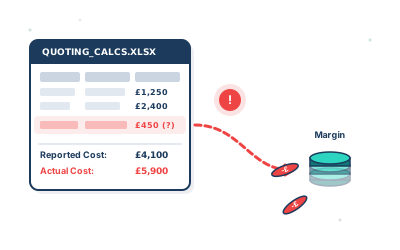
You closed out last quarter with decent turnover. The work was good. Clients paid. But when you looked at net margin, it was thinner than it should have been, and you couldn't point to one reason why.
That gap between what you quoted and what you actually made is rarely one big mistake. It's usually the accumulation of five small process failures compounding quietly over months. Here's what they look like.
Sign 1: One person owns all the pricing
If quotes have to go through one person, because they're the only one who knows the rules, you have a fragile process, not a reliable one.
The problem isn't the person. It's that their expertise exists entirely inside their head. They know that jobs with tight access add 15% to the labour estimate. They know that this material supplier quotes in tonnes but your model works in metres. They know the three clients who always push back on price, and by roughly how much.
None of that is written down anywhere. It can't be.
When that person is unavailable, whether on holiday, on site all day, or eventually gone, either quotes slow to a halt or someone else takes a guess. Guesses tend to cost margin.
The fix isn't a better spreadsheet (though that helps). It's externalising the rules into a system that anyone with a basic understanding of the trade can run correctly.
Sign 2: Your win rate looks fine but margin isn't
A 38% win rate sounds healthy. But if the jobs you're winning are the lower-margin ones, you've built a pipeline that's busy but not profitable.
This happens because feel-based pricing tends to be accurate on familiar work and inconsistent on anything non-standard. You've priced the standard job a hundred times and you know it cold. The unusual configuration, you pad for uncertainty. Clients often pick the former; competitors sometimes win the latter.
| Job type | Avg quoted margin | Avg actual margin | Variance |
|---|---|---|---|
| Repeat/standard | 26% | 24% | −2% |
| Custom/non-standard | 34% | 17% | −17% |
The custom jobs look like your best work on paper. They're often the worst in practice, because the uncertainty padding goes in the wrong place. You pad what you can see and miss the uncosted hours, the rework, the material variance on a spec you haven't sourced before.
If you can't break margin by job type and compare quoted versus actual, you're flying without instruments.
Sign 3: The same job gets quoted differently by different people
Ask two people in your business to quote an identical job independently. If the numbers differ by more than 5%, your process has a consistency problem.
This isn't a skills gap. It's a structural one. When pricing logic lives in people's heads or in loosely structured spreadsheets, variation is the natural result. One person is more cautious on labour. Another uses last year's material rate. A third forgets the handling charge. A fourth applies the access surcharge only when the client mentions it.
The margin risk cuts both ways. If your more optimistic estimator tends to win the competitive jobs, you may be systematically under-pricing your most contested work. If the cautious one quotes the jobs that go to tender, you may be losing profitable work to competitors who've simply built a tighter model.
A consistent quoting process produces a number that reflects what the job actually costs, not who happened to price it that day.
Sign 4: Discounting happens at point of sale without a floor
The call goes well. The client is close. Someone says: "Can you do anything on the price?" And someone on your side says yes, without knowing where the margin sits.
This is how a 22% gross margin job becomes a 9% one. Not through bad pricing, but through a discount given without reference to the floor.
The discipline isn't refusing to discount. It's knowing what you can absorb before you agree to anything.
Quoted price:         £14,800
Estimated cost:       £11,400
Gross margin:         £3,400  (22%)

10% discount:        −£1,480
Remaining margin:     £1,920  (13%)

15% discount:        −£2,220
Remaining margin:     £1,180  (9%) ← below your minimum threshold
If those numbers aren't visible during the sales conversation, the discount decision is a guess. Sometimes it's a fine guess. Often it costs you three or four points of margin on every job where someone applies a little pressure.
Sign 5: When a job loses money, you can't trace why
Every specialist business has jobs that come in under-margin. The question is whether you learn from them.
If your post-job review amounts to "it took longer than expected" or "materials cost more than we thought," that's a symptom, not a cause. The cause is usually one of a small set of things: a rule applied incorrectly, a cost category missing from the model, a scope assumption that didn't match what turned up on site.
If you can't trace the specific line in your estimate where the variance happened, you can't correct the model. The same error recurs on the next similar job, and the one after that. Over a year, that's not one lost job. It's a structural margin leak.
Quoting systems that are auditable, where you can see exactly which rule produced which number, give you a feedback loop. Spreadsheets without version control, and gut feel, don't.
What these five signs have in common
Each one points to the same underlying issue: the logic that governs your pricing isn't formalised, isn't consistent, and isn't visible enough to manage.
That's not a failing. It's how most specialist businesses start. The senior estimator's knowledge is real and valuable. The spreadsheet worked fine when volumes were lower. The problem is that an informal process doesn't scale, doesn't survive staff changes, and doesn't give you the data you need to protect margin as the business grows.
The work I do at Etminan AI Solutions starts by extracting that pricing logic: sitting with whoever holds it, mapping the rules, and rebuilding them as a structured, testable quoting tool. Every rule stays the client's own, just made consistent and auditable.
If any of the five signs above sound familiar, a free 30-minute call is a sensible starting point. You walk me through how you price today, and I will tell you where the margin risk looks highest and whether a structured quoting tool would make a real difference. Book one here.